Robotic Lawn Mowers: The Complete Buyer’s Guide for Midwest Homeowners
 The idea sounds almost too good to be true: instead of spending an hour or more mowing every week, a small autonomous machine quietly leaves its charging station, cuts the lawn, returns to recharge, and repeats the process throughout the season.
That is exactly what modern robotic lawn mowers are designed to do.
The technology has changed dramatically from the early robot mowers that wandered randomly around a yard and depended on buried perimeter wires. Modern systems can use GPS, RTK positioning, cameras, LiDAR, AI-powered obstacle detection, and digital mapping to mow organized patterns while staying inside virtual boundaries. Some systems require no perimeter wire at all.
But not every robotic mower is right for every lawn.
If you are considering an autonomous mower for a property in Wisconsin, Michigan, Minnesota, or elsewhere in the Upper Midwest, here is what actually matters before you buy.
What Is a Robotic Lawn Mower?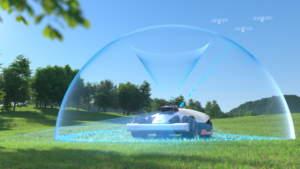
A robotic lawn mower is a battery-powered mower designed to maintain a lawn automatically.
Instead of waiting until the grass becomes noticeably tall and then removing a large amount once a week, robotic mowing generally works best through frequent, smaller cuts.
The mower follows a programmed schedule, cuts a small amount of grass, returns to its charging station when necessary, recharges, and continues maintaining the property.
Those tiny clippings fall back into the turf rather than being collected in a bag. Frequent mowing produces smaller clippings that can break down relatively quickly and return organic material to the lawn.
The real change, however, is not simply replacing one type of mower with another.
It changes lawn mowing from a weekly project into an automated maintenance process.
How Do Wire-Free Robotic Lawn Mowers Know Where to Go?
One of the biggest advances in robotic mowing has been the move away from physical perimeter wires.
Traditional robot mowers often required a wire installed around the lawn. The mower detected that wire and stayed inside the defined mowing area.
Many newer wireless robotic lawn mowers instead create a virtual map of the property.
Depending on the mower, positioning may involve:
- GPS or GNSS satellite positioning
- RTK positioning for improved location accuracy
- Network RTK services
- Cameras and AI vision
- LiDAR
- Ultrasonic or other obstacle sensors
- A combination of several technologies
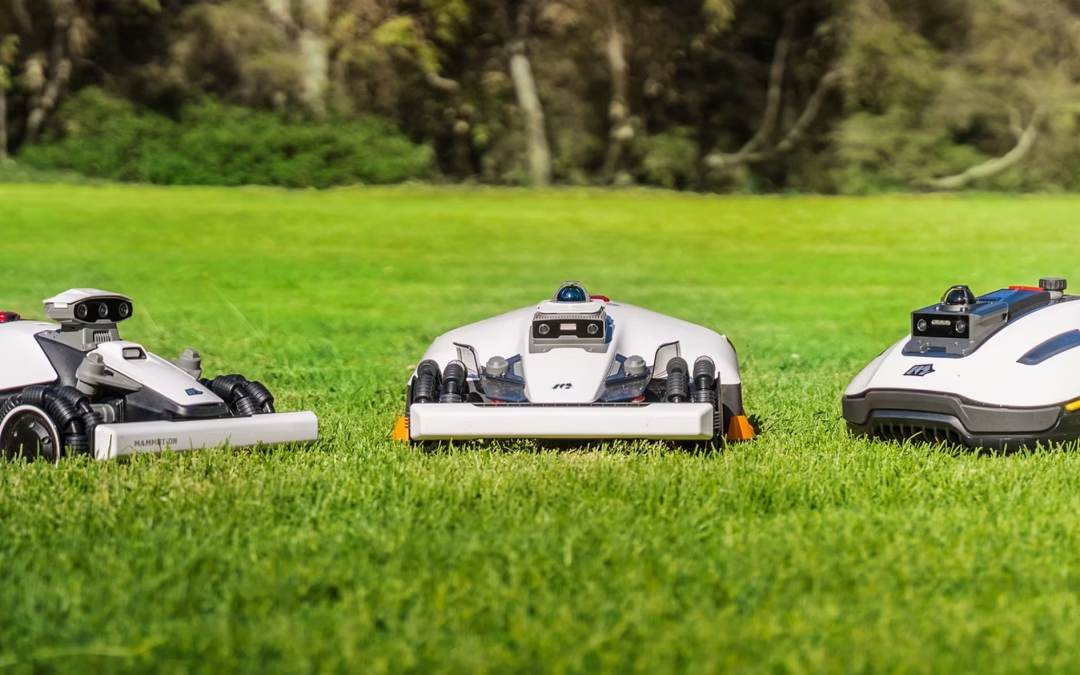
Modern Mammotion platforms, for example, use combinations of positioning, camera, AI, and LiDAR technologies depending on the product.
The result is something much closer to mapping a robotic vacuum than installing an old-fashioned lawn boundary system.
Digital mowing zones, pathways, restricted areas, and boundaries can be created for the property. If the landscaping changes later, those virtual boundaries can generally be adjusted without digging up the lawn.
1. Start With Your Actual Mowing Area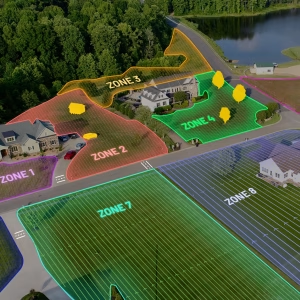
The first number homeowners usually look at is acreage.
That matters, but total property size is not necessarily the same as mowable lawn area.
A one-acre property might contain:
- A 2,500-square-foot house
- Driveway
- Patio
- Landscaping beds
- Woods
- Garden
- Shed
- Other non-turf areas
The mower only needs capacity for the turf it will actually maintain.
Measure your realistic mowing area and then consider some additional capacity rather than choosing a machine operating at its absolute limit.
Complex yards, hills, multiple mowing zones, obstacles, and heavy seasonal growth can all increase the amount of work the mower must perform.
2. Look at Your Hills, Not Just Your Acres
Slope capability can be more important than raw acreage.
A relatively small lawn with steep hills may demand substantially more from a mower than a large, open, flat property.
Pay attention to:
Maximum slope rating: How steep of a grade can the machine safely handle?
Drive system: Two-wheel-drive and all-wheel-drive robotic mowers can behave very differently on slopes.
Traction: Wet grass, loose soil, exposed roots, and uneven terrain can challenge a mower even if the mathematical slope falls within its specifications.
Transitions: The hardest area may not be the hill itself. A sharp transition at the top or bottom can create traction or clearance problems.
This is one reason professional property evaluation can be valuable. Choosing purely from an acreage specification does not tell you how the mower will behave on your actual terrain.
3. Count Your Mowing Zones
Imagine two half-acre lawns.
Property A is one wide-open rectangle.
Property B has a front lawn, backyard, side yard, trees, islands, walkways, a driveway crossing, fenced areas, and several narrow passages.
Both contain roughly the same amount of grass.
They are completely different robotic mowing environments.
Modern autonomous mowers can handle surprisingly complicated properties, but the mower needs to travel effectively between the places it is supposed to maintain.
Before buying, identify:
- Separate lawn sections
- Narrow passages
- Gates
- Driveway crossings
- Sidewalk crossings
- Landscape islands
- Fenced areas
- Areas where the mower should never travel
A good robotic mower installation is therefore partly about the mower and partly about designing the map correctly.
4. Think About Trees, Buildings, and Navigation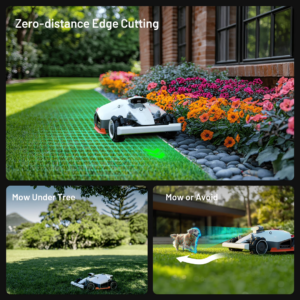
Satellite-based navigation has made wire-free mowing possible, but every property has a different environment.
Large trees, heavy canopy, tall structures, narrow areas between buildings, retaining walls, and other features can affect what a navigation system can see.
That does not automatically mean robotic mowing will not work.
It means navigation technology should be matched to the property.
Some newer machines combine satellite positioning with cameras, AI vision, or LiDAR rather than depending on one positioning method alone.
This is an important distinction when comparing robotic mowers.
Do not simply ask:
“Does it have GPS?”
Ask:
“How does this mower maintain its position in the difficult parts of my yard?”
That is a much better buying question.
5. Evaluate Obstacles and Everyday Yard Life
Your mower is not operating in a laboratory.
Real lawns contain:
- Trees
- Fire pits
- Lawn furniture
- Toys
- Pets
- Sticks
- Pinecones
- Landscape edging
- Sprinkler heads
- Trampolines
- Play equipment
Modern robot mowers use sensors and increasingly sophisticated obstacle-detection systems to navigate these environments. Lawnamation’s systems are designed around autonomous operation, mapping, obstacle avoidance, scheduled mowing, and automatic return-to-charge behavior.
Still, obstacle detection should not be treated as permission to leave absolutely anything in the lawn.
A quick property check remains good practice, particularly after storms, construction, parties, or heavy yard use.
Automation dramatically reduces mowing labor.
It does not eliminate common sense.
6. Understand the Difference Between Mowing and Edging
A robotic mower can dramatically reduce the amount of lawn work required, but homeowners should have realistic expectations around edges.
The blade system sits underneath the mower body for safety. Depending on the mower and the shape of the lawn, there may still be areas along walls, raised landscape borders, trees, or other obstacles that occasionally require trimming.
Properties with mower-friendly edges can minimize this work.
For example, grass that meets a flush sidewalk or hardscape may allow the mower to travel partially over the edge and cut much closer than grass ending against a vertical retaining wall.
If you are designing new landscaping, thinking about robotic mowing before installing beds, walls, and borders can make the entire property easier to automate.
7. Do Not Ignore Installation and Support
This is probably the most overlooked part of buying a robotic mower.
A robot mower is both outdoor power equipment and a technology product.
Correct setup may include:
- Choosing the charging-station location
- Mapping the property
- Establishing virtual boundaries
- Creating mowing zones
- Creating travel corridors
- Setting no-go areas
- Setting cutting height
- Adjusting mowing schedules
- Configuring connectivity
- Updating firmware
- Testing difficult terrain
- Optimizing navigation
A perfectly capable mower with a poor map can deliver a frustrating experience.
A properly selected mower with a properly designed setup can be remarkably hands-off.
That is why LAWNAMATION provides professional installation, mapping, setup, product recommendations, troubleshooting, servicing, demos, and ongoing support rather than simply shipping a box and disappearing.
Are Robotic Lawn Mowers Good for the Grass?
They can fit very well with good turf-management practices because of how frequently they mow.
Instead of allowing grass to become tall between weekly mowing sessions, the mower can remove small amounts more often.
Frequent mowing creates very small clippings that return to the turf rather than producing piles of long clippings. Major robotic-mower manufacturers specifically design their machines around this frequent-cutting and mulching approach.
The lawn also maintains a more consistently “just mowed” appearance because it never has as much time to grow noticeably shaggy between cuts.
Of course, mowing is only one part of lawn health. Soil conditions, fertility, irrigation, grass species, disease pressure, shade, compaction, and weather still matter.
A robot mower automates mowing.
It does not magically replace proper turf care.
Who Is a Robotic Mower Best For?
Robotic mowing makes particular sense for homeowners who:
- Spend significant time mowing every week
- Pay someone else to mow
- Own a second home or seasonal property
- Travel frequently
- Want a consistently maintained appearance
- Have physically demanding terrain
- Prefer quieter electric equipment
- Want to automate repetitive property maintenance
- Simply have better things to do with their summer
For many people, the biggest return is not measured only in dollars.
It is measured in hours.
If mowing takes 90 minutes each week for 24 weeks, that is 36 hours of your summer spent cutting grass—not including fueling, cleanup, maintenance, transportation, or trimming.
Automation gives a large portion of that time back.
The Best Robotic Lawn Mower Is the One That Fits Your Property
There is no single robotic mower that is best for every homeowner.
A small flat city lawn does not need the same machine as a multi-acre property with steep hills.
The right mower depends on the combination of:
Lawn size + slope + terrain + layout + navigation environment + desired cut + service expectations.
That is why we prefer to look at the property instead of simply recommending the most expensive machine.
LAWNAMATION specializes in robotic mowing and serves homeowners, businesses, contractors, and independent dealers across the Upper Midwest. We provide robotic mower recommendations, professional setup and mapping, troubleshooting, service, and demonstrations, with a Wisconsin showroom and product support behind the equipment we sell.
If you are wondering whether an autonomous mower will actually work on your lawn, the easiest next step is to see the technology in action.
Schedule a LAWNAMATION demo or contact us about your property.
We can look at your lawn, discuss acreage, hills, obstacles, mowing zones, and expectations, and help determine what robotic mowing would realistically look like at your home.
Your lawn still needs to be mowed.
You just do not necessarily have to be the one mowing it.