Mammotion YUKA 3000 With Sweeper cleans up the fall

Mammotion YUKA 3000 With Sweeper cleans up the fall

There comes a point every fall when mowing the lawn stops being the annoying part


It’s the leaves. You blow them into piles. Move them again. Bag them, tarp them, mulch them or haul them somewhere. Then the wind picks up, another tree drops, and a few days later the lawn looks like you never touched it.

The Mammotion YUKA 3000 with its sweeper/bagger offers a solution, a slower and more deliberate solution.

Instead of waiting for the leaves to become a weekend project, you can have a robot moving across the lawn regularly, mowing when needed, sweeping up leaves and other loose debris, and unloading what it collects at a dumping spot you choose. That is what makes the YUKA 3000 the right tool for the job. The YUKA can do 90% of the fall yard clean-up without any help. You get the 10% it might miss from time to time or wet leaves that are stubbornly stuck to the ground.

And our friends at Lawnamation currently have a limited number of YUKA 3000 packages with the sweeper/bagger listed for sale. We can't verify that they are literally the last units in the country. Mammotion, the inventor/manufacturer, has independent dealers around the U.S. so we won't make that claim. But this mower-and-sweeper combination is harder to find, which makes the remaining dealer inventory worth paying attention to. If you feel like this is the best option for you, don’t wait. That’s our best advice.
YUKA 3000 Side View

The Better Way to Automate Leaves

The temptation is to imagine the YUKA tackling a lawn buried under six inches of wet November leaves. That has changed, a traditional fall cleanup is reactive. You wait for enough leaves to fall, devote a few hours to cleaning them up, and then repeat the process after the next windy day.

The Yuka 3000 sees that differently

Send the YUKA out regularly and it can collect leaves while they're still manageable. Instead of one enormous cleanup, you're preventing that enormous cleanup from accumulating in the first place.

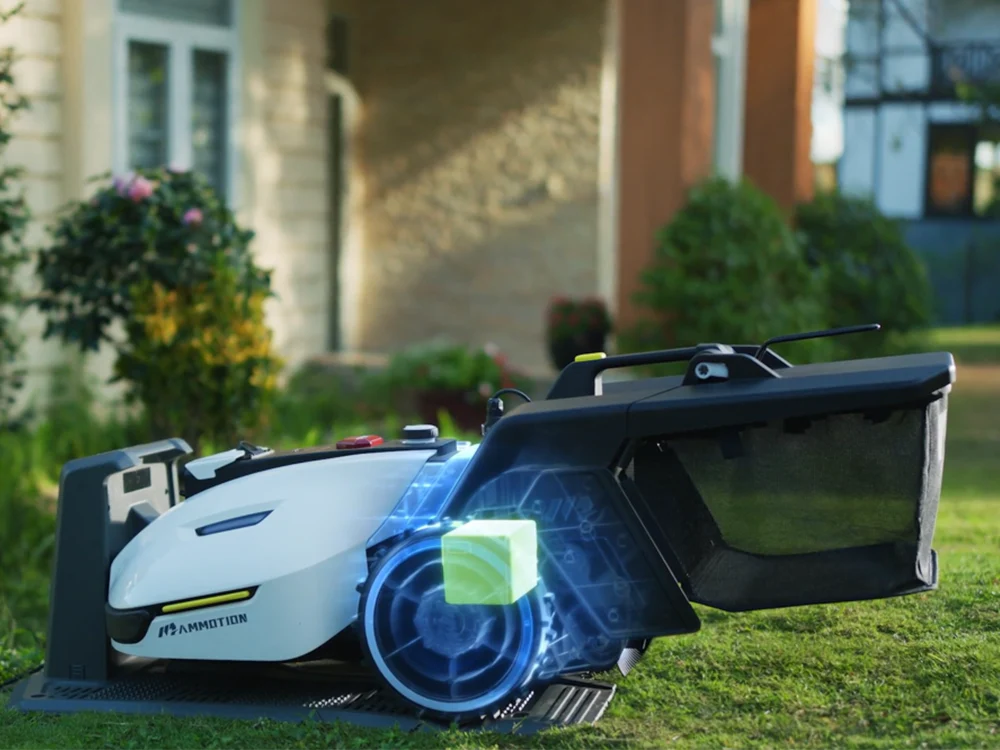
Mammotion designed the YUKA's optional sweeper to collect material such as leaves, grass clippings and lawn debris. Once the sweeper is installed, you can create dumping spots in the Mammotion app. The mower can collect material during its task, travel to the designated dumping location, empty the basket and continue working.

Put that dumping spot near a compost pile, tree line or another convenient collection area and the whole process starts to look less like “leaf cleanup” and more like routine lawn maintenance happening in the background.
Automate your fall yard clean up with YUKA 3000

A Robot Mower That Does More Than Mow

Without the sweeper, the YUKA is already a capable perimeter-wire-free robotic mower.

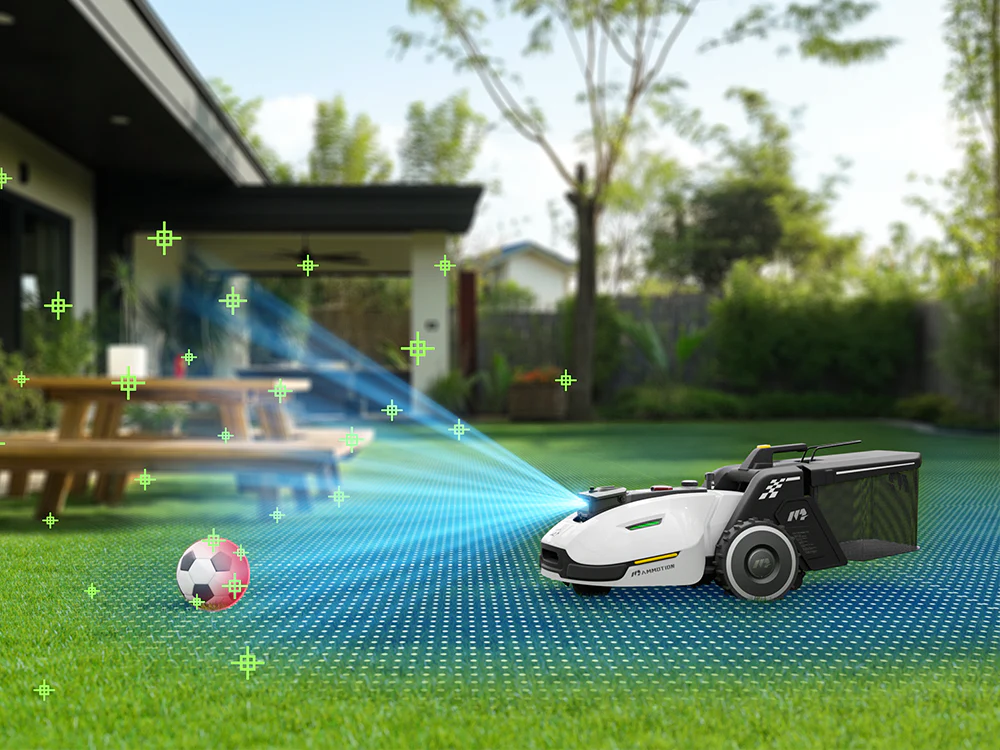
The YUKA 3000 combines satellite positioning and vision-based navigation, allows you to create virtual mowing areas in the Mammotion app, can work across multiple zones and automatically returns to its charging station. The YUKA 3000 is the version intended for lawns up to approximately three quarters of an acre.  The YUKA mows, and does the leaves while it’s out there. One machine. Two chores you don't particularly want.

What Does It Take to Set Up a YUKA 3000?

The first setup requires more involvement than rolling a push mower out of the garage. Once you've established the charging station, connected the mower and mapped the property, you're not repeating that process every weekend.

  1. Give the mower a home - Start with the charging station. You'll want a reasonably flat location where the YUKA can enter and leave without fighting landscaping, tight corners or other obstacles. Connect the station, place the mower on the charger and let it power up.

Think of the charging station as home base. The mower leaves from there, completes its assigned work and returns there when it needs power.

  1. Connect the mower and update it - Next comes the Mammotion app. Add the mower to your account, establish its required connections and install any available firmware updates before doing serious mapping. Depending on the positioning method used with your particular installation, you'll also configure the mower's positioning connection. The YUKA platform supports Mammotion's positioning and navigation technologies without requiring a buried perimeter wire around the lawn.
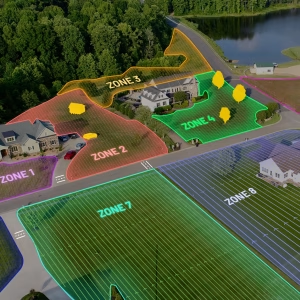
  2. Show YUKA where the lawn is - This is the part that makes a robotic mower feel different from a conventional mower. You create the areas you want maintained in the app. For more complicated boundaries, you can guide the mower around the edge of the lawn and define the work area. You can then create additional areas for separate sections of grass and channels that allow the mower to travel between them or return to its charging station. Have a flower bed in the middle of the lawn?

Create a no-go zone. A pond, exposed roots, landscaping or some other area where you don't want a robot wandering? You're essentially teaching the mower the rules of your property once so it can follow them repeatedly.

  1. Add the sweeper and choose where the leaves go

Now comes the part that separates YUKA from most robotic mowers. Install the rear sweeper/bagger and enable sweeping in the task settings. Then create at least one dumping location. Mammotion defines the dumping spot as the location where YUKA sends the grass clippings, leaves and debris it has collected. Spend a little time thinking about this location.

The most convenient dumping spot may not be the closest one. It may be the place where you'll eventually mulch the leaves, load them into a trailer or add them to compost.

  1. Watch the first run - Don't schedule it for 2:00 a.m. and hope for the best. Watch the first run.

You'll quickly see whether a boundary should move a few inches, whether the mower needs a wider passage, whether a no-go zone could be improved or whether your chosen dumping location makes sense. Once you make those adjustments, you can let the mower do it’s work, alone, quiet, automatically.

There Are Limits—and That's Fine

Properties with significant slopes deserve extra consideration. Mammotion specifies a lower slope capability when the YUKA is operating with its sweeper attached; its support documentation lists approximately 18%, or 10 degrees, with the sweeper.

It will do 70, 80 or 90 percent of an annoying recurring job can still dramatically change how much time that job takes.

Why the YUKA 3000 Makes Sense in Fall

Most think about robotic mowers in spring. That's understandable. Spring is when people start thinking about grass. But the YUKA may actually be easiest to appreciate when the leaves start turning. Look outside on a Saturday in October. The lawn needs to be cut. Leaves are scattered everywhere. You could spend the afternoon mowing, blowing, raking and hauling.

Or…

You could have a machine that's been quietly maintaining the grass all week begin collecting leaves before you've finished your first cup of coffee. And that equates to time doing other things.

Finding a YUKA 3000 With the Sweeper

Mammotion has discontinued the model year production so there will not be large shipments to America any time soon. Lawnamation currently lists the YUKA 3000 with the sweeper/bagger included in its mower inventory. Mammotion still recognizes and supports the YUKA 3000 platform, but availability of the mower itself varies by market and dealer.

We can't tell you that Lawnamation has the last YUKA 3000s in America. Nobody without visibility into every independent dealer's warehouse could responsibly make that claim. What we can tell you is that Lawnamation has them listed now, and they are limited and will sell out.

So if you've specifically been looking for the YUKA 3000 because of its sweeper it makes sense to check availability before assuming you'll find one later.
Lawnamation Partners with FJDynamics in Robot Line Painting

FOR IMMEDIATE RELEASE

Lawnamation Adds FJDynamics to Its Commercial Automation Lineup

Musson Landscaping division expands into autonomous mowing, robotic field marking, precision mapping and 3D scanning while growing its Upper Midwest dealer network

LAND O’ LAKES, Wis. — August 25, 2026 — Lawnamation, a division of Musson Landscaping LLC, has added FJDynamics to its growing lineup of robotic and autonomous outdoor equipment.

The move expands Lawnamation beyond residential robotic mowing into larger-scale commercial turf mowing, athletic field marking, precision mapping, RTK positioning and 3D site scanning.

Lawnamation already works with dealers, contractors and retail customers and plans to continue expanding across the Upper Midwest. The company is actively looking for established businesses in Wisconsin, Michigan, Minnesota and surrounding states that serve landscaping, outdoor power equipment, golf, sports turf, agriculture or related commercial markets and want to add autonomous technology to their product offering.

The initial FJDynamics lineup includes the FJD RM21, FRX, Titan, PaintMaster Pro, PaintMaster Mini, Trion V4e Pro, Trion V1 Base Station and Trion P2 LiDAR Scanner. Products can be viewed at Lawnamation.info.

For Lawnamation product specialist Rod Kemppainen, the decision is less about adding another equipment brand and more about where the outdoor industry is headed.

“I have been around long enough to watch a lot of technology get overpromised,” Kemppainen said. “What interests me about FJDynamics is that these products solve actual problems. They mow large and complex areas, mark fields, map properties, provide accurate positioning and collect site data. Those are jobs contractors, schools, golf courses, municipalities and property managers are already spending time and money doing.”

The FJDynamics lineup gives Lawnamation several ways to address those needs. The FRX and Titan provide commercial autonomous mowing options, while the RM21 is a multifunctional turf-care platform. The PaintMaster Pro  automates athletic field layout and painting, while FJD's Trion products add professional mapping, positioning and 3D scanning capabilities.

“Field marking is a good example of where automation makes sense quickly,” Kemppainen said. “It is repetitive, it takes time and accuracy matters. If a machine can handle that while your people are doing work that requires more experience and judgment, the value is easy to understand.  Additionally the paint savings are in excess of 50%”

Lawnamation operates as a division of Musson Landscaping, which serves Northern Wisconsin and Michigan's Upper Peninsula. That relationship gives the company firsthand experience with the realities that contractors and property managers face every day, including labor shortages, equipment costs, weather, and the need to get work completed on schedule.

That experience also shapes Lawnamation's approach to selling automation.

“We do not want to sell somebody a robot just because we can,” Kemppainen said. “We want to understand what they are doing now, where their time and labor are going and what problem they are trying to solve. If automation makes sense, we will say so. If it does not, we will say that too.”

Lawnamation provides in-person demonstrations, training, product support and ongoing service to help customers successfully integrate robotic and autonomous technology into their operations.

The company sees opportunities for FJDynamics products across landscape contracting, golf, sports facilities, schools, municipalities, commercial properties and agriculture.

Kemppainen said the goal is not simply replacing people with machines.

“The future is not just robots doing everything,” he said. “It is good people using better tools. Automation can take repetitive work off their schedule and let them spend more time on the work that requires experience and judgment.”

FJDynamics products are now available through Lawnamation.info.

Product demonstrations, commercial consultations and dealer inquiries from Wisconsin, Michigan, Minnesota and Iowa are welcome.

Lawnamation
A Division of Musson Landscaping LLC
4259 County Road B
Land O’ Lakes, WI 54540

Phone: 715-204-9784
Web: Lawnamation.info
Email: rod@mussonlandscaping.com

About Lawnamation

Lawnamation provides robotic mowing and autonomous outdoor technology for residential and professional customers. As a division of Musson Landscaping LLC, a company combines hands-on landscaping and lawn-care experience with practical applications for robotic and autonomous equipment.

About FJDynamics

FJDynamics develops robotic, automation, positioning and digital-mapping technology for labor-intensive industries, including landscaping, agriculture and surveying.

Midwestern Robotic Lawn Mower Buyers Guide

Robotic Lawn Mowers: The Complete Buyer’s Guide for Midwest Homeowners

Robot Lawn Mower For SaleThe idea sounds almost too good to be true: instead of spending an hour or more mowing every week, a small autonomous machine quietly leaves its charging station, cuts the lawn, returns to recharge, and repeats the process throughout the season.
That is exactly what modern robotic lawn mowers are designed to do.

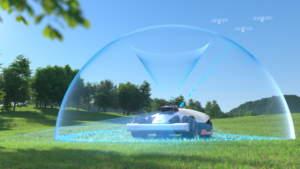
The technology has changed dramatically from the early robot mowers that wandered randomly around a yard and depended on buried perimeter wires. Modern systems can use GPS, RTK positioning, cameras, LiDAR, AI-powered obstacle detection, and digital mapping to mow organized patterns while staying inside virtual boundaries. Some systems require no perimeter wire at all.

But not every robotic mower is right for every lawn.

If you are considering an autonomous mower for a property in Wisconsin, Michigan, Minnesota, or elsewhere in the Upper Midwest, here is what actually matters before you buy.

What Is a Robotic Lawn Mower?Robotic Mower With Tri-fusion

A robotic lawn mower is a battery-powered mower designed to maintain a lawn automatically.

Instead of waiting until the grass becomes noticeably tall and then removing a large amount once a week, robotic mowing generally works best through frequent, smaller cuts.

The mower follows a programmed schedule, cuts a small amount of grass, returns to its charging station when necessary, recharges, and continues maintaining the property.

Those tiny clippings fall back into the turf rather than being collected in a bag. Frequent mowing produces smaller clippings that can break down relatively quickly and return organic material to the lawn.

The real change, however, is not simply replacing one type of mower with another.

It changes lawn mowing from a weekly project into an automated maintenance process.

How Do Wire-Free Robotic Lawn Mowers Know Where to Go?

One of the biggest advances in robotic mowing has been the move away from physical perimeter wires.

Traditional robot mowers often required a wire installed around the lawn. The mower detected that wire and stayed inside the defined mowing area.

Many newer wireless robotic lawn mowers instead create a virtual map of the property.

Depending on the mower, positioning may involve:

  • GPS or GNSS satellite positioning
  • RTK positioning for improved location accuracy
  • Network RTK services
  • Cameras and AI vision
  • LiDAR
  • Ultrasonic or other obstacle sensors
  • A combination of several technologies

Modern Mammotion platforms, for example, use combinations of positioning, camera, AI, and LiDAR technologies depending on the product.

The result is something much closer to mapping a robotic vacuum than installing an old-fashioned lawn boundary system.

Digital mowing zones, pathways, restricted areas, and boundaries can be created for the property. If the landscaping changes later, those virtual boundaries can generally be adjusted without digging up the lawn.

1. Start With Your Actual Mowing AreaAutonomous Robotic Lawn Care

The first number homeowners usually look at is acreage.

That matters, but total property size is not necessarily the same as mowable lawn area.

A one-acre property might contain:

  • A 2,500-square-foot house
  • Driveway
  • Patio
  • Landscaping beds
  • Woods
  • Garden
  • Shed
  • Other non-turf areas

The mower only needs capacity for the turf it will actually maintain.

Measure your realistic mowing area and then consider some additional capacity rather than choosing a machine operating at its absolute limit.

Complex yards, hills, multiple mowing zones, obstacles, and heavy seasonal growth can all increase the amount of work the mower must perform.

2. Look at Your Hills, Not Just Your Acres

Slope capability can be more important than raw acreage.

A relatively small lawn with steep hills may demand substantially more from a mower than a large, open, flat property.

Pay attention to:

Maximum slope rating: How steep of a grade can the machine safely handle?

Drive system: Two-wheel-drive and all-wheel-drive robotic mowers can behave very differently on slopes.

Traction: Wet grass, loose soil, exposed roots, and uneven terrain can challenge a mower even if the mathematical slope falls within its specifications.

Transitions: The hardest area may not be the hill itself. A sharp transition at the top or bottom can create traction or clearance problems.

This is one reason professional property evaluation can be valuable. Choosing purely from an acreage specification does not tell you how the mower will behave on your actual terrain.

3. Count Your Mowing Zones

Imagine two half-acre lawns.

Property A is one wide-open rectangle.

Property B has a front lawn, backyard, side yard, trees, islands, walkways, a driveway crossing, fenced areas, and several narrow passages.

Both contain roughly the same amount of grass.

They are completely different robotic mowing environments.

Modern autonomous mowers can handle surprisingly complicated properties, but the mower needs to travel effectively between the places it is supposed to maintain.

Before buying, identify:

  • Separate lawn sections
  • Narrow passages
  • Gates
  • Driveway crossings
  • Sidewalk crossings
  • Landscape islands
  • Fenced areas
  • Areas where the mower should never travel

A good robotic mower installation is therefore partly about the mower and partly about designing the map correctly.

4. Think About Trees, Buildings, and NavigationThe AI Powered sensors give this mower vision

Satellite-based navigation has made wire-free mowing possible, but every property has a different environment.

Large trees, heavy canopy, tall structures, narrow areas between buildings, retaining walls, and other features can affect what a navigation system can see.

That does not automatically mean robotic mowing will not work.

It means navigation technology should be matched to the property.

Some newer machines combine satellite positioning with cameras, AI vision, or LiDAR rather than depending on one positioning method alone.

This is an important distinction when comparing robotic mowers.

Do not simply ask:

“Does it have GPS?”

Ask:

“How does this mower maintain its position in the difficult parts of my yard?”

That is a much better buying question.

5. Evaluate Obstacles and Everyday Yard Life

Your mower is not operating in a laboratory.

Real lawns contain:

  • Trees
  • Fire pits
  • Lawn furniture
  • Toys
  • Pets
  • Sticks
  • Pinecones
  • Landscape edging
  • Sprinkler heads
  • Trampolines
  • Play equipment

Modern robot mowers use sensors and increasingly sophisticated obstacle-detection systems to navigate these environments. Lawnamation’s systems are designed around autonomous operation, mapping, obstacle avoidance, scheduled mowing, and automatic return-to-charge behavior.

Still, obstacle detection should not be treated as permission to leave absolutely anything in the lawn.

A quick property check remains good practice, particularly after storms, construction, parties, or heavy yard use.

Automation dramatically reduces mowing labor.

It does not eliminate common sense.

6. Understand the Difference Between Mowing and Edging

A robotic mower can dramatically reduce the amount of lawn work required, but homeowners should have realistic expectations around edges.

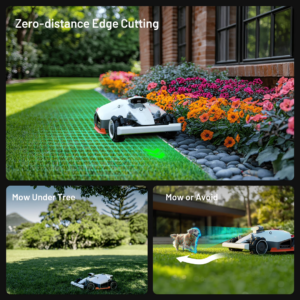
The blade system sits underneath the mower body for safety. Depending on the mower and the shape of the lawn, there may still be areas along walls, raised landscape borders, trees, or other obstacles that occasionally require trimming.

Properties with mower-friendly edges can minimize this work.

For example, grass that meets a flush sidewalk or hardscape may allow the mower to travel partially over the edge and cut much closer than grass ending against a vertical retaining wall.

If you are designing new landscaping, thinking about robotic mowing before installing beds, walls, and borders can make the entire property easier to automate.

7. Do Not Ignore Installation and Support

This is probably the most overlooked part of buying a robotic mower.

A robot mower is both outdoor power equipment and a technology product.

Correct setup may include:

  • Choosing the charging-station location
  • Mapping the property
  • Establishing virtual boundaries
  • Creating mowing zones
  • Creating travel corridors
  • Setting no-go areas
  • Setting cutting height
  • Adjusting mowing schedules
  • Configuring connectivity
  • Updating firmware
  • Testing difficult terrain
  • Optimizing navigation

A perfectly capable mower with a poor map can deliver a frustrating experience.

A properly selected mower with a properly designed setup can be remarkably hands-off.

That is why LAWNAMATION provides professional installation, mapping, setup, product recommendations, troubleshooting, servicing, demos, and ongoing support rather than simply shipping a box and disappearing.

Are Robotic Lawn Mowers Good for the Grass?

They can fit very well with good turf-management practices because of how frequently they mow.

Instead of allowing grass to become tall between weekly mowing sessions, the mower can remove small amounts more often.

Frequent mowing creates very small clippings that return to the turf rather than producing piles of long clippings. Major robotic-mower manufacturers specifically design their machines around this frequent-cutting and mulching approach.

The lawn also maintains a more consistently “just mowed” appearance because it never has as much time to grow noticeably shaggy between cuts.

Of course, mowing is only one part of lawn health. Soil conditions, fertility, irrigation, grass species, disease pressure, shade, compaction, and weather still matter.

A robot mower automates mowing.

It does not magically replace proper turf care.

Who Is a Robotic Mower Best For?

Robotic mowing makes particular sense for homeowners who:

  • Spend significant time mowing every week
  • Pay someone else to mow
  • Own a second home or seasonal property
  • Travel frequently
  • Want a consistently maintained appearance
  • Have physically demanding terrain
  • Prefer quieter electric equipment
  • Want to automate repetitive property maintenance
  • Simply have better things to do with their summer

For many people, the biggest return is not measured only in dollars.

It is measured in hours.

If mowing takes 90 minutes each week for 24 weeks, that is 36 hours of your summer spent cutting grass—not including fueling, cleanup, maintenance, transportation, or trimming.

Automation gives a large portion of that time back.

The Best Robotic Lawn Mower Is the One That Fits Your Property

There is no single robotic mower that is best for every homeowner.

A small flat city lawn does not need the same machine as a multi-acre property with steep hills.

The right mower depends on the combination of:

Lawn size + slope + terrain + layout + navigation environment + desired cut + service expectations.

That is why we prefer to look at the property instead of simply recommending the most expensive machine.

LAWNAMATION specializes in robotic mowing and serves homeowners, businesses, contractors, and independent dealers across the Upper Midwest. We provide robotic mower recommendations, professional setup and mapping, troubleshooting, service, and demonstrations, with a Wisconsin showroom and product support behind the equipment we sell.

If you are wondering whether an autonomous mower will actually work on your lawn, the easiest next step is to see the technology in action.

Schedule a LAWNAMATION demo or contact us about your property.

We can look at your lawn, discuss acreage, hills, obstacles, mowing zones, and expectations, and help determine what robotic mowing would realistically look like at your home.

Your lawn still needs to be mowed.

You just do not necessarily have to be the one mowing it.

Why Municipalities, Schools, and Park Systems are Turning to Robotic Lawn Care

Across the country, municipalities, school districts, and park departments are facing a growing challenge: maintaining large amounts of green space with shrinking labor pools, rising equipment costs, and increasing public expectations. Traditional grounds maintenance methods are becoming harder to sustain financially, especially as fuel, insurance, labor, and equipment replacement costs continue climbing year after year.


At the same time, communities expect parks, athletic fields, school campuses, and public facilities to look better than ever.


Autonomous robotic lawn care is emerging as one of the most effective solutions to this challenge. What was once viewed as niche technology is now becoming a practical and scalable tool for public grounds maintenance operations. Robotic mowing systems are helping municipalities reduce operational costs, improve turf quality, enhance sustainability efforts, and reallocate staff toward higher-value work.


Solving One of the Biggest Budget Problems in Grounds Maintenance

For most municipalities and school districts, mowing is often the single most labor-intensive and lowest-margin part of grounds maintenance operations. Large commercial mowers require dedicated operators for hours each day during peak growing season. Add overtime, seasonal staffing shortages, fuel expenses, maintenance, and equipment wear, and mowing quickly becomes one of the most expensive recurring operational costs.


Robotic mowing fundamentally changes this model.

Instead of assigning employees to sit on mowing equipment for entire shifts, autonomous mowers continuously maintain turf with minimal direct supervision. Existing staff can then focus on:

  • Athletic field preparation

  • Irrigation management

  • Landscaping improvements

  • Playground maintenance

  • Tree care

  • Weed management

  • Public works projects

  • Facility maintenance tasks


For many organizations, robotic mowing is not about replacing employees — it is about allowing already understaffed departments to operate more efficiently with the workforce they currently have.


Consistently Better Turf Quality

One of the most overlooked advantages of robotic mowing is the dramatic improvement in turf health.

Traditional mowing often removes a large portion of the grass blade once or twice per week. This creates stress on the turf and can contribute to discoloration, weed pressure, shallow roots, and inconsistent growth patterns.

Robotic mowers operate on a much more frequent schedule, trimming only a very small amount of grass at a time. This creates a healthier biological growing cycle that produces:

  • Denser turf

  • Stronger root systems

  • Improved color consistency

  • Reduced weed intrusion

  • Better moisture retention

  • More even athletic playing surfaces


For schools and parks with athletic facilities, this can significantly improve both aesthetics and field performance.


Reduced Soil Compaction and Turf Damage

Heavy commercial mowing equipment repeatedly traveling over turf causes soil compaction over time. Compacted soil limits oxygen movement, reduces water infiltration, weakens root growth, and increases turf stress.


Robotic mowers are substantially lighter than traditional zero-turn mowers or tractor-style equipment. Their lower ground pressure dramatically reduces compaction and helps preserve healthier soil conditions.

This is particularly valuable for:

  • Soccer complexes

  • Football practice fields

  • Baseball outfields

  • Community parks

  • Cemetery grounds

  • School campuses


Reducing compaction can also lower long-term turf renovation and aeration costs.


Lower Fuel and Equipment Costs

Municipal fleets are expensive to operate. Fuel consumption, hydraulic repairs, oil changes, engine maintenance, belts, blades, tires, and downtime all add up quickly.


Robotic mowing systems operate electrically and consume only a fraction of the energy required by conventional mowing equipment.


This can significantly reduce:

  • Fuel expenses

  • Fleet maintenance costs

  • Equipment downtime

  • Oil and fluid usage

  • Engine-related repairs

  • Fleet replacement frequency


Over time, many municipalities discover robotic mowing provides a far more predictable and controllable operating cost structure.


Quiet Operation Improves Public Experience

Traditional commercial mowers are loud and disruptive — especially in parks, residential areas, and school environments.

Robotic mowing systems operate quietly enough to maintain turf without significantly disrupting:

  • School classes

  • Park visitors

  • Office operations

  • Neighborhood residents

  • Outdoor community events


Because robotic systems can mow quietly throughout the day, organizations gain far greater flexibility in scheduling maintenance without negatively impacting the public.


Supporting Sustainability and Environmental Goals

Sustainability initiatives are becoming increasingly important for municipalities, universities, and school districts. Autonomous mowing aligns extremely well with these goals.


Robotic lawn care helps reduce:

  • Carbon emissions

  • Fuel consumption

  • Noise pollution

  • Chemical dependency

  • Water demand through healthier turf growth


Additionally, robotic mowers naturally mulch fine clippings back into the lawn, recycling nutrients and helping reduce fertilizer requirements.

For organizations pursuing sustainability certifications or environmental improvement initiatives, robotic mowing provides measurable operational benefits.


Improved Safety for Grounds Crews

Grounds maintenance personnel face daily exposure to:

  • Heat stress

  • Loud noise

  • Vibration

  • Traffic hazards

  • Steep slopes

  • Flying debris

  • Equipment rollover risks


Autonomous mowing systems reduce the amount of time employees spend operating heavy machinery while still maintaining large properties efficiently.


Modern robotic systems also include sophisticated safety technology such as:

  • GPS positioning

  • Obstacle detection

  • Lift and tilt sensors

  • Automatic blade shutoff

  • Remote monitoring capabilities


This creates a safer operational environment for maintenance teams.


Smart Technology Investment for Public Spaces

Communities increasingly expect municipalities and schools to operate efficiently while embracing smart technology solutions. Robotic mowing systems demonstrate innovation while delivering visible operational benefits taxpayers can actually see.

Well-maintained parks, athletic fields, and campuses improve public perception while autonomous maintenance technology showcases forward-thinking leadership.


In many communities, robotic mowing systems also become educational tools that support:

  • STEM programs

  • Sustainability education

  • Technology demonstrations

  • Workforce development initiatives


The Future of Public Grounds Maintenance

Autonomous robotic lawn care is rapidly transitioning from emerging technology to mainstream operational infrastructure. As labor shortages continue and maintenance costs rise, municipalities and educational institutions are searching for solutions that improve efficiency without sacrificing quality.

Robotic mowing offers a rare opportunity to accomplish both.


By reducing labor demands, improving turf health, lowering operating costs, minimizing environmental impact, and enhancing public spaces, robotic lawn care is helping redefine what modern grounds maintenance looks like.


For municipalities, schools, and park systems planning for the future, autonomous mowing is no longer simply an innovation — it is becoming a strategic operational advantage.

Why Autonomous Robotic Mowing Is Becoming a Competitive Advantage for Commercial Landscape Contractors

For many commercial lawn and landscape contractors, mowing is both the foundation of the business and one of its greatest operational challenges. While mowing contracts often generate steady recurring revenue, they are also commonly the highest-cost and lowest-margin portion of a contractor’s service portfolio. Labor shortages, rising equipment costs, fuel expenses, insurance exposure, and transportation inefficiencies continue to compress profitability across the industry.


As autonomous robotic mowing technology continues to mature, forward-thinking contractors are beginning to rethink the traditional mowing model entirely. Rather than replacing landscaping companies, robotic mowing gives contractors an opportunity to improve margins, stabilize labor demands, increase property quality, and reposition their businesses toward higher-value services.


The Margin Problem in Traditional Mowing

Commercial mowing is labor intensive. A significant percentage of a contractor’s operational expenses are tied directly to mowing crews, including:

  • Labor wages and overtime

  • Employee recruitment and retention

  • Workers compensation insurance

  • Fuel and transportation costs

  • Equipment maintenance and replacement

  • Downtime from weather or staffing shortages

  • Trailer, truck, and fleet expenses


Despite these costs, mowing is often highly competitive and price-sensitive. Many contractors find themselves competing against low-cost providers, forcing margins downward even as operational expenses rise. In many cases, mowing becomes a necessary service to retain accounts while the real profitability comes from enhancement work, irrigation, snow removal, fertilization, or landscape construction.

Autonomous robotic mowing offers a way to fundamentally change that equation.


Reducing Labor Dependency

One of the most immediate benefits of robotic mowing is the reduction in labor dependency. Finding reliable mowing labor has become increasingly difficult for contractors nationwide. Seasonal turnover, absenteeism, and training requirements create constant operational pressure.


Autonomous mowers allow contractors to deploy mowing capacity without requiring a full-time operator on every property. Instead of dedicating multiple employees to repetitive mowing tasks, companies can reallocate labor toward services that generate higher margins and require greater skill, such as:

  • Landscape enhancements

  • Irrigation installation and service

  • Plant health care

  • Hardscaping

  • Athletic field preparation

  • Customer relationship management

Rather than replacing employees entirely, robotic mowing often allows companies to operate more efficiently with the labor force they already have.


Improved Profitability Per Property (and Employee)

Traditional mowing crews typically visit a property once per week and remove a substantial amount of grass at each cut. This process requires significant labor hours, fuel consumption, and transportation time.


Robotic mowers operate differently. They mow continuously or on highly frequent schedules, trimming only small amounts of grass at a time. This creates several operational advantages:

  • Reduced total labor hours per property

  • Lower fuel costs

  • Less equipment wear and tear

  • Fewer truck rolls and site visits

  • More predictable scheduling

  • Reduced overtime during peak growth periods


For contractors managing large commercial portfolios, even modest labor savings across dozens or hundreds of properties can dramatically improve annual profitability.


Better Turf Quality and Health

Robotic mowing is not only an operational improvement — it also produces measurable agronomic benefits.

Because robotic mowers cut grass more frequently and remove only a small portion of the blade at a time, turf experiences less stress compared to traditional weekly mowing. The result is often:

  • Healthier turf density

  • Improved color consistency

  • Reduced scalping

  • Fewer clippings

  • Better moisture retention

  • Reduced weed pressure over time


Additionally, robotic mowers are significantly lighter than traditional commercial zero-turn mowers, which reduces soil compaction. Excessive soil compaction is a common issue on commercial properties and athletic fields, particularly in wet conditions. Reduced compaction can improve root development, water infiltration, and overall turf resilience.


For contractors, improved turf quality can translate into stronger client retention and differentiation from competitors.


Lower Equipment and Fuel Costs

Fuel and maintenance are major ongoing expenses for commercial mowing operations. Conventional mowing fleets require:

  • Gasoline or diesel fuel

  • Oil changes

  • Hydraulic maintenance

  • Blade replacement

  • Engine repairs

  • Tire replacement

  • Transportation between sites


Electric autonomous mowers dramatically reduce many of these costs. With fewer moving parts and reduced mechanical complexity, maintenance requirements are often substantially lower than traditional gas-powered equipment.


Over time, contractors may also reduce fleet size requirements, trailer needs, and overall equipment replacement cycles.


Enhancing Safety and Risk Management

Commercial mowing carries inherent safety risks. Operator injuries, property damage, and roadside exposure all create liability concerns for contractors.

Autonomous mowing systems can help reduce some of these risks by limiting employee exposure to repetitive mowing operations and hazardous roadside conditions. Many robotic systems also include advanced safety features such as obstacle detection, GPS tracking, geofencing, and automatic shutoff systems.


Reducing workplace injuries and equipment incidents can positively impact insurance costs and operational stability over time.


A New Service Model for Contractors

Autonomous mowing also creates opportunities for entirely new business models within the landscape industry.

Some contractors are beginning to offer:

  • Robotic mowing installation

  • Ongoing monitoring and maintenance

  • Subscription-based robotic mowing programs

  • Technology support and fleet management

  • Autonomous mowing consulting for municipalities, schools, and HOAs


Rather than competing solely on mowing price, contractors can position themselves as technology-driven service providers delivering higher consistency and innovation.


Early Adoption Creates Competitive Advantage

The landscape industry is entering a period of technological transition similar to what agriculture experienced with GPS guidance and automation. Contractors who begin understanding and implementing autonomous mowing today may gain meaningful advantages over competitors who wait.


Early adopters can:

  • Build operational expertise

  • Establish vendor relationships

  • Differentiate their brand

  • Improve labor efficiency sooner

  • Position themselves as innovation leaders in their markets


As labor pressures and operational costs continue to rise, autonomous robotic mowing is increasingly becoming less of a novelty and more of a strategic business tool.


Conclusion

For commercial lawn and landscape contractors, mowing has historically been a necessary but margin-compressed service line. Autonomous robotic mowing offers a pathway to improve operational efficiency, reduce labor dependency, lower long-term costs, and deliver better turf quality simultaneously.


While robotic mowing may not replace every traditional mowing application immediately, it is rapidly becoming a practical and scalable solution for many commercial properties. Contractors who embrace the technology strategically can improve profitability while positioning their businesses for the future of the landscape industry.