.png)
Beneficial Areas for Commercial Robotic Lawn Mowing
- Dale Kleffman
- Apr 14
- 2 min read

What areas really work the best for robotic mowing? That is a fair question and while all areas work it is true certain areas and conditions surrounding areas do make the most sense to implement robotic mowing. Robotic mowing can handle virtually any area but really do excel in certain areas compared to traditional mowing. These areas include:
Remote or difficult to access areas
Areas with significant slope
Hazardous areas like a golf range or shooting range
Hazardous areas around roads or airports
Areas with many obstacles to maneuver around like tree farms , cemeteries, or orchards.
Areas that are noise or pollution sensitive - like wildlife refuges, zoos, or churches.
Areas that present hazards to people and heavier equipment - wetland, pond, or river edges.
Areas that require more frequent mowing like golf courses.
This isn’t to say a robotic mower won’t work great on a traditional yard or a wide open area of turf like a football field - it absolutely will. There is just an even more significant time savings and reduction in hazards over traditional mowing when we look at the areas and conditions in the first paragraph.
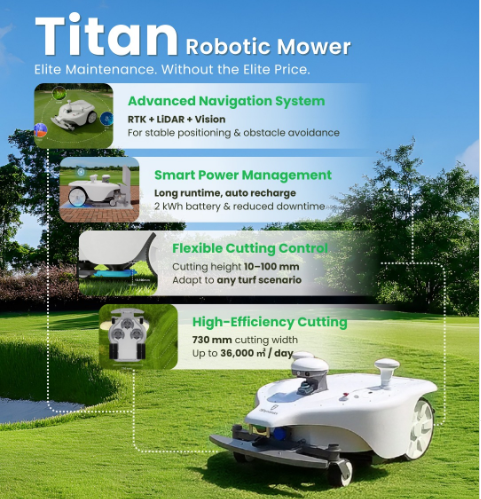
Most robotic mowers for turf applications weigh between 50 and 400 pounds so they don’t tend to have the impact on turf that larger equipment does. Nearly all of them mow a narrower pattern than gas or diesel engine driven equipment but when you can work 24 hours a day and don’t require a person to operate that is offset rather quickly. The narrower width allows for more uniform cutting and maneuverability around objects. Robotic mowers also have a much lower center of gravity than traditional mowing equipment. This provides for more stability on slopes to begin with and adding control autonomously lets robotic mowers avoid situations where a person could get into trouble.

Comments